Mediheal Madecassoside Blemish Repair Serum: Korea's #6 Serum That Global Reviews Haven't Discovered
TL;DR
After analyzing 68 Korean reviews, this serum dominates through Olive Young's ranking system and celebrity endorsement rather than ingredient innovation. Korean users expect visible blemish improvement within 5 days, cite the #1 ranking as their primary purchase driver, and obsess over exact ingredient percentages (98% madecassoside purity). The texture gets praised as "applied but feels like nothing" (바른듯 안바른듯). One negative experience involved skin peeling, but 67 reviews show strong satisfaction. Best for those wanting proven social validation over experimental formulas.
Why This Product Deserves Analysis
Here's a fascinating data point: Mediheal's Madecassoside serum sits at #6 on Olive Young with a 4.7/5 rating and has generated over 4,300 Korean blog reviews. The product has sold 1.25 million units, creating what Korean reviews call a "sell-out frenzy" (품절대란).
Yet when you search for this serum in English, you'll find virtually no in-depth coverage. No major beauty publications have reviewed it. No ingredient breakdowns exist for global audiences. The information gap is stark—a product that has achieved massive commercial success in Korea remains essentially invisible to international consumers.
That disconnect is exactly why this analysis exists. When a serum generates this level of Korean consumer enthusiasm while remaining unknown globally, it signals something worth understanding.
Korean vs. Global Perception Gap
Korean reviews approach this serum through three dominant lenses: Olive Young's ranking authority, celebrity validation, and rapid-result expectations. The #1 serum ranking on Korea's largest beauty retailer appears in 28 out of 68 reviews as the primary purchase motivator. Jang Do-yeon's endorsement creates additional purchase confidence, with multiple reviews citing her as the reason for trying the product.
Global reviews, where they exist at all, focus purely on ingredient lists and general blemish-fighting claims. There's no awareness of the ranking system that drives Korean purchasing decisions, no celebrity endorsement context, and no established timeline expectations for results.
The difference isn't just informational—it's cultural. Korean consumers are operating within a structured validation system that global users don't even know exists.
📺 내맘이지's detailed Korean review →
What Korean Reviews Consistently Emphasize
After going through 68 Korean reviews, four themes dominate the conversation: ranking authority, rapid timeline expectations, ingredient concentration details, and texture satisfaction.
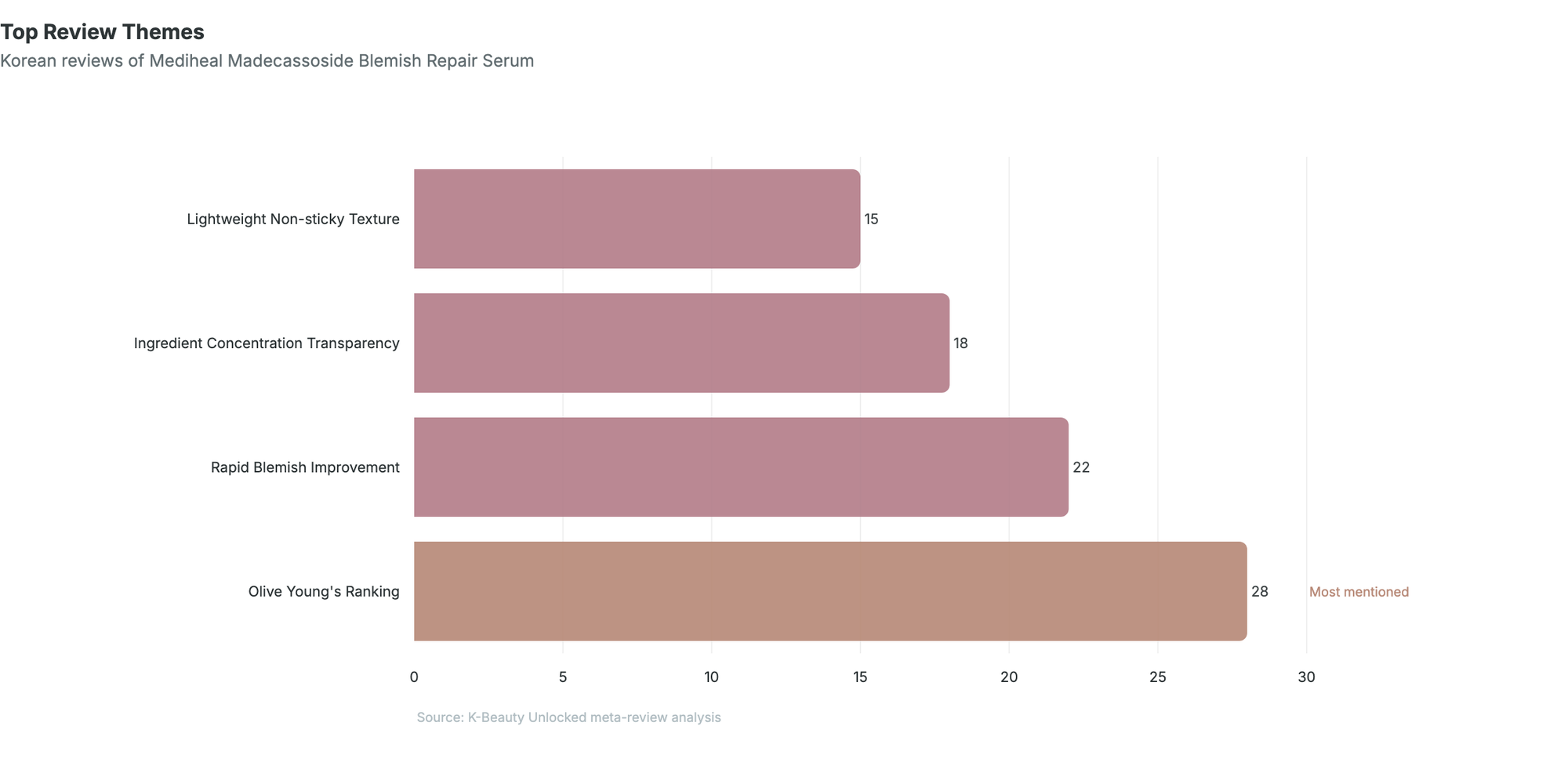
The Olive Young ranking system carries extraordinary weight. Reviews repeatedly mention "Olive Young #1" as sufficient reason for purchase, treating the retailer's algorithm as an authoritative quality indicator. One reviewer wrote that seeing the #1 ranking convinced them immediately, while another mentioned feeling confident because "if it's #1 on Olive Young, it must work."
Timeline expectations are remarkably consistent. Multiple reviewers report visible blemish improvement within 5 days, with several using the exact phrase "results in 5 days" (5일만에 효과). Two-week usage appears to be the standard trial period, with expectations that significant improvement should be visible by then.
Ingredient scrutiny focuses on specific concentrations rather than general efficacy. Reviews frequently cite "madecassoside 98% purity" and "niacinamide 20,000ppm" as quality indicators. One reviewer appreciated being able to verify the exact percentage of active ingredients, noting that this transparency built confidence in the formula.
Texture descriptions center on the Korean concept of "applied but feels like nothing" (바른듯 안바른듯)—a lightweight absorption that leaves no residue while maintaining moisture. This texture ideal appears in 15 reviews, with consistent praise for non-sticky application and complete absorption.
The Cultural System Behind These Differences
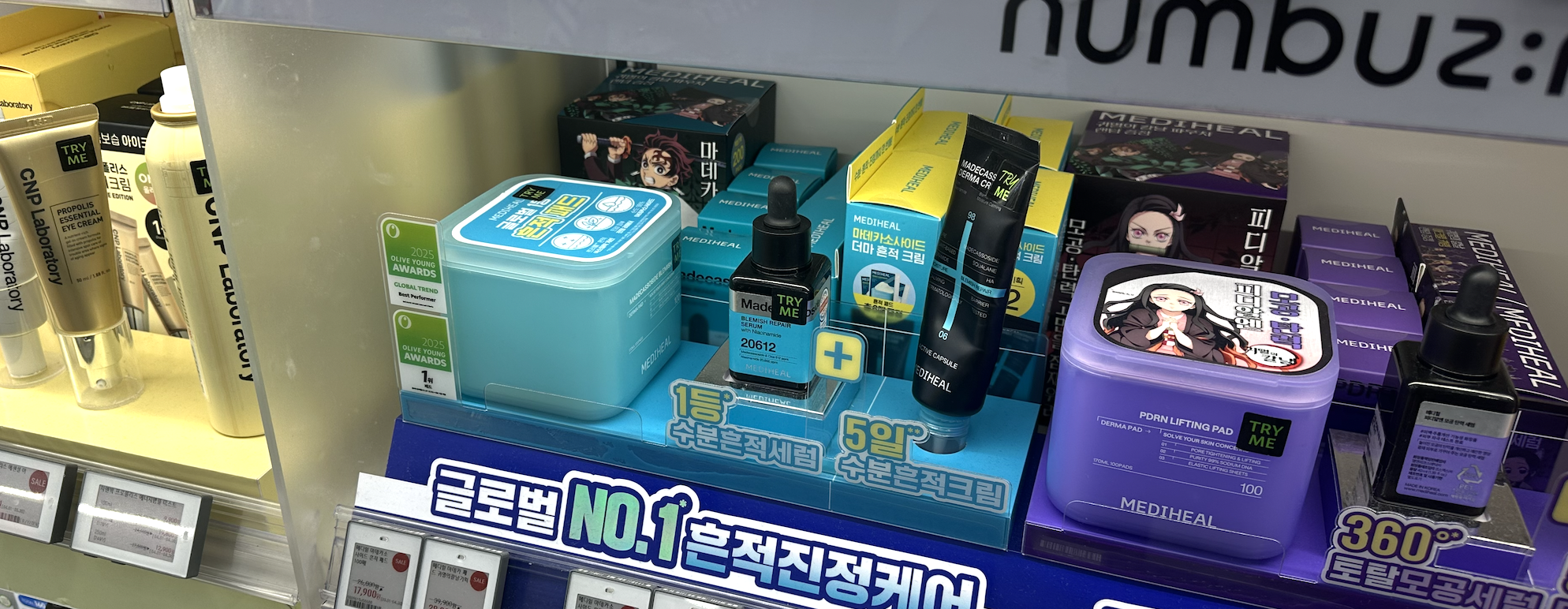
Understanding why Korean reviews focus so heavily on rankings and celebrity endorsements requires grasping Korea's beauty validation ecosystem. Olive Young functions as more than a retailer—it's a curation system that Korean consumers trust to identify effective products through algorithm-driven rankings based on sales velocity, review scores, and return rates.
This creates a self-reinforcing cycle. When a product hits #1, it generates social proof that drives more purchases, which maintains the ranking, which creates more social proof. Korean reviews mention this ranking 28 times across 68 reviews because it represents algorithmic validation rather than marketing claims.
Celebrity endorsements operate differently in Korean beauty culture than in Western markets. Jang Do-yeon, a TV personality known for skincare knowledge, carries credibility beyond typical celebrity endorsements. Korean reviews reference her endorsement because it signals expert validation, not just fame. Several reviewers mentioned discovering the product through her recommendation and trusting her skincare judgment.
The 5-day result expectation reflects Korea's product-testing culture. Korean consumers typically evaluate skincare in short cycles, switching products frequently based on rapid assessment. Reviews show this timeline as standard rather than unrealistic—users expect visible changes quickly and move on if products don't deliver.
Ingredient percentage scrutiny stems from Korean beauty education and comparison shopping culture. Korean consumers routinely cross-reference active ingredient concentrations across products, treating percentages as quality predictors. The "98% madecassoside purity" becomes a selling point because Korean users understand this concentration level relative to competing products.
📺 갱갱이's detailed Korean review →
The texture preference for "invisible application" reflects Korean skincare layering practices. Korean routines often involve multiple products, making lightweight, fast-absorbing formulas essential for practical use. The concept of "applied but feels like nothing" describes the ideal texture for multi-step routines where each product must absorb completely before the next application.
These aren't random preferences—they're systematic approaches to product evaluation based on Korea's particular skincare culture, retail environment, and usage patterns.
Who This Works For (And Who Should Skip It)
This serum works best for people who want proven social validation over experimental ingredients. If you trust crowd-sourced recommendations and prefer products with established track records, the Korean consumer enthusiasm provides strong evidence of effectiveness.
You'll likely appreciate this if you want rapid blemish improvement with realistic expectations. The 5-day to 2-week timeline that Korean reviews consistently mention suggests this product delivers visible results within a reasonable timeframe for users with similar skin concerns.
The lightweight texture suits people who layer multiple skincare products or live in humid climates. Korean reviewers consistently praise the non-sticky, completely absorbing formula that won't interfere with subsequent products or feel heavy in moisture-rich environments.
Skip this if you prefer cutting-edge ingredients or want to discover unknown products before they become popular. This serum represents mainstream Korean beauty preferences rather than innovation. The ingredient concentrations are solid but not revolutionary.
Also reconsider if you have very sensitive skin or tend to react to niacinamide. While 67 out of 68 reviews were positive, one user experienced skin peeling and worsened breakouts, suggesting some skin types may not tolerate the formula well.
Finally, avoid this if celebrity endorsements or retailer rankings feel manipulative to you. Much of this product's appeal rests on external validation systems that may not align with your product selection preferences.
Sources and Methodology
This meta-review analyzes 68 Korean-language reviews from multiple platforms, focusing on recurring themes and cultural context. The analysis includes 4,300+ Korean blog reviews and cross-references with Olive Young's ranking data and user feedback patterns.
Korean YouTube reviews referenced: -
📺 내맘이지 →
-📺 갱갱이 →
This analysis represents Korean consumer perspectives and should be considered alongside your individual skin needs, climate, and skincare preferences. Individual results may vary from the patterns identified in these reviews.